How to Start Investing with Just $100
Many people believe they need thousands of dollars to start investing, but that’s simply not true. Thanks to modern investment platforms, fractional shares, exchange-traded funds (ETFs), and low-cost index funds, you can begin building wealth with as little as $100.
The most important factor in successful investing isn’t how much money you start with—it’s starting early and investing consistently. Even a small investment can grow significantly over time through the power of compound interest.
Whether your goal is financial freedom, early retirement, buying a home, or simply growing your savings, this beginner-friendly guide will show you exactly how to start investing with just $100.
—
Why You Should Start Investing Early
One of the biggest advantages new investors have is time. The earlier you begin, the longer your investments have to grow.
Benefits of Starting Early
Take advantage of compound interest
Build healthy investing habits
Grow wealth steadily over time
Reduce the pressure of making large future investments
Learn how markets work with minimal risk
Waiting for the “perfect” time often means missing years of potential growth.
—
Is $100 Enough to Start Investing?
Absolutely.
While $100 won’t make you rich overnight, it can be the beginning of a lifetime of investing.
Today’s online brokerages and investment apps allow you to:
Buy fractional shares of expensive companies
Invest in diversified ETFs
Purchase low-cost index funds
Set up automatic recurring investments
The key is consistency rather than the initial amount.
—
Step 1: Set Your Financial Goals
Before investing, determine **why** you’re investing.
Common goals include:
Building long-term wealth
Saving for retirement
Buying a home
Funding education
Achieving financial independence
Creating passive income
Your goals will help determine the best investment strategy.
—
Step 2: Build an Emergency Fund First
Before investing, make sure you have enough cash to handle unexpected expenses.
Financial experts generally recommend saving **three to six months of essential living expenses in an easily accessible account.
This prevents you from selling investments during emergencies.
If you don’t yet have an emergency fund, consider splitting your first $100 between savings and investing.
—
Step 3: Understand Your Risk Tolerance
Every investment carries some level of risk.
Ask yourself:
How would you react if your investment temporarily lost value?
Are you investing for five years or thirty years?
Do you prefer stability or higher growth potential?
Generally, younger investors with longer time horizons can tolerate more market volatility.
—
Step 4: Choose the Right Investment Account
Selecting the appropriate account is an important first step.
Depending on your country, you may choose:
A standard brokerage account
A tax-advantaged retirement account
A micro-investing platform
Look for providers that offer:
No account minimums
Low fees
Fractional shares
Easy-to-use mobile apps
Automatic investment options
Avoid accounts with unnecessary maintenance charges.
—
Step 5: Decide Where to Invest Your $100
There are several beginner-friendly investment options.
1. Index Funds
Index funds track a broad stock market index rather than relying on active management.
Benefits
Diversification
Low fees
Long-term growth potential
Beginner-friendly
Many financial experts recommend index funds as the best starting point.
—
2. Exchange-Traded Funds (ETFs)
ETFs combine the diversification of mutual funds with the flexibility of stocks.
Advantages include:
Low expense ratios
Easy trading
Broad market exposure
Suitable for long-term investing
A single ETF can provide exposure to hundreds of companies.
—
3. Fractional Shares
Some well-known companies have high share prices, making them difficult for beginners to buy.
Fractional shares allow you to purchase a portion of a share instead of the entire share.
For example, if a stock costs $500 per share, you can invest just $20 or $50 and still own part of that company.
This makes investing more accessible.
—
4. Dividend Stocks
Dividend-paying companies distribute a portion of their profits to shareholders.
Benefits include:
Regular income
Potential long-term growth
Dividend reinvestment opportunities
Dividend investing is popular among investors seeking passive income.
—
5. Robo-Advisors
Robo-advisors automatically create and manage diversified portfolios based on your goals and risk tolerance.
Advantages:
Low management fees
Automatic rebalancing
Beginner-friendly
Hands-off investing
They are ideal for investors who prefer simplicity.
—
Step 6: Diversify Your Investments
One of the most important investing principles is diversification.
Instead of investing all $100 in a single company, consider spreading it across multiple investments through ETFs or index funds.
Diversification reduces the impact of poor performance from any one investment.
—
Step 7: Invest Consistently
Your first $100 is just the beginning.
Set up automatic monthly contributions—even if it’s only $25 or $50.
This strategy, known as dollar-cost averaging, allows you to invest regularly regardless of market conditions.
Benefits include:
Builds discipline
Reduces emotional investing
Lowers average purchase costs over time
Consistency is more important than investing large amounts occasionally.
—
The Power of Compound Interest
Compound interest allows your investment earnings to generate additional earnings over time.
Example
Suppose you invest:
Initial investment: $100
Monthly contribution: $100
Average annual return: 8%
Over time, your portfolio has the potential to grow significantly because each year’s returns are reinvested.
The earlier you start, the greater the compounding effect.
—
Common Beginner Investment Mistakes
Avoid these common errors:
Waiting Too Long
Many people delay investing because they believe they need more money.
Starting small today is often better than waiting years.
—
Trying to Time the Market
Predicting market highs and lows consistently is extremely difficult.
Long-term investing generally outperforms frequent trading for most people.
—
Chasing “Hot” Stocks
Avoid investing based on social media hype or short-term trends.
Focus on quality investments with long-term potential.
—
Ignoring Fees
High management fees can significantly reduce investment returns over time.
Choose low-cost investment options whenever possible.
—
Selling During Market Declines
Market downturns are normal.
Historically, markets have recovered over time.
Selling during temporary declines may lock in losses and reduce long-term growth.
—
Tips to Grow Your First $100
Once you’ve started investing, continue building your portfolio.
Increase Contributions
Whenever your income rises, increase your monthly investment amount.
Reinvest Dividends
Automatically reinvest dividends to accelerate compound growth.
Continue Learning
Improve your financial knowledge by reading books, listening to podcasts, and following reputable financial educators.
Stay Patient
Successful investing is measured in years—not days.
—
Sample Beginner Investment Plan
Here’s an example of how you could invest your first $100:
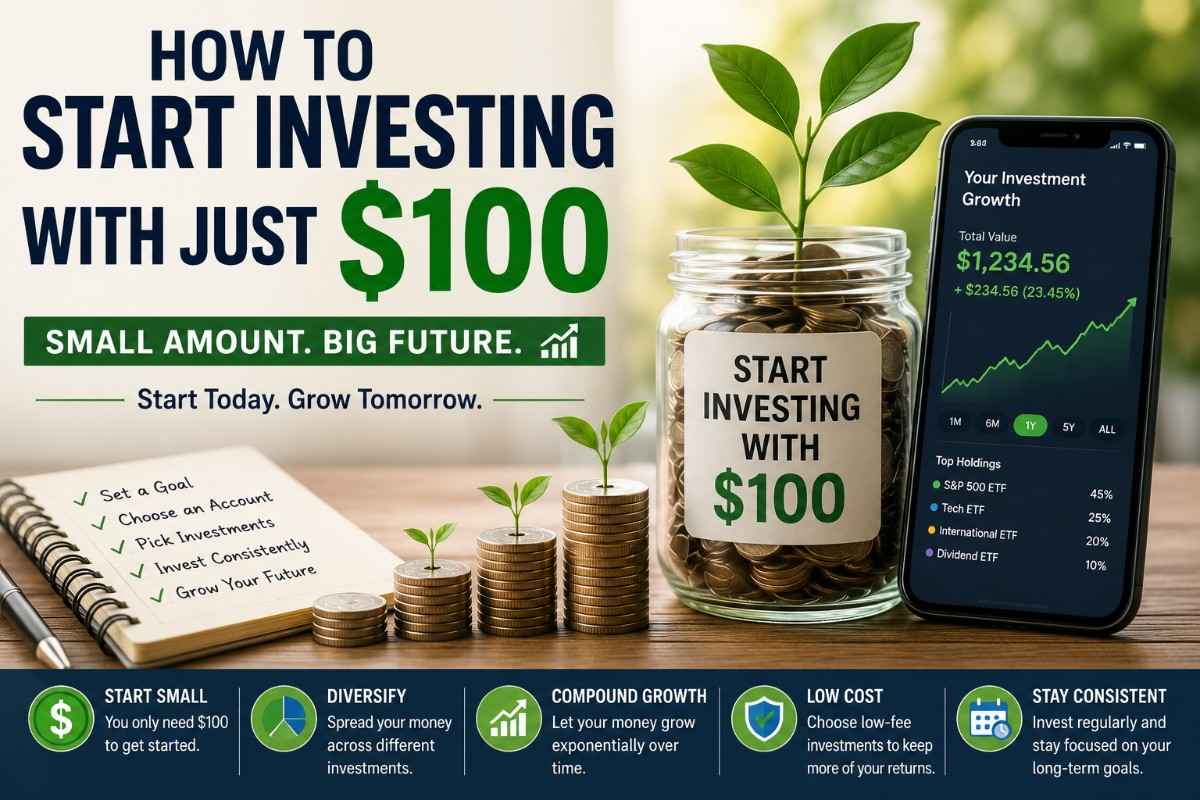
$60 into a broad-market index fund
$20 into an international ETF
$20 into a dividend-focused ETF
As your portfolio grows, you can continue investing monthly while maintaining diversification.
—
Frequently Asked Questions
Can I Really Start Investing with Only $100?
Yes. Many investment platforms allow you to begin with small amounts and purchase fractional shares.
—
Should I Save or Invest First?
Ideally, build a small emergency fund before investing heavily. Once you have basic financial security, begin investing consistently.
—
Is Investing Risky?
All investments carry some level of risk. However, diversified long-term investments have historically provided attractive returns compared with simply holding cash.
—
How Much Should I Invest Every Month?
Invest whatever fits comfortably within your budget. Even small, regular contributions can grow substantially over time through compound interest.
—
Final Thoughts
Starting your investment journey with just $100 proves that building wealth isn’t about having a large amount of money—it’s about developing the habit of investing consistently.
By setting clear financial goals, choosing low-cost investments such as index funds or ETFs, diversifying your portfolio, and investing regularly, you can create a strong foundation for long-term financial success.
Remember, every successful investor started somewhere. Your first $100 may seem small today, but with patience, discipline, and the power of compound growth, it can become the first step toward financial independence.
The best investment you can make is the decision to start today.