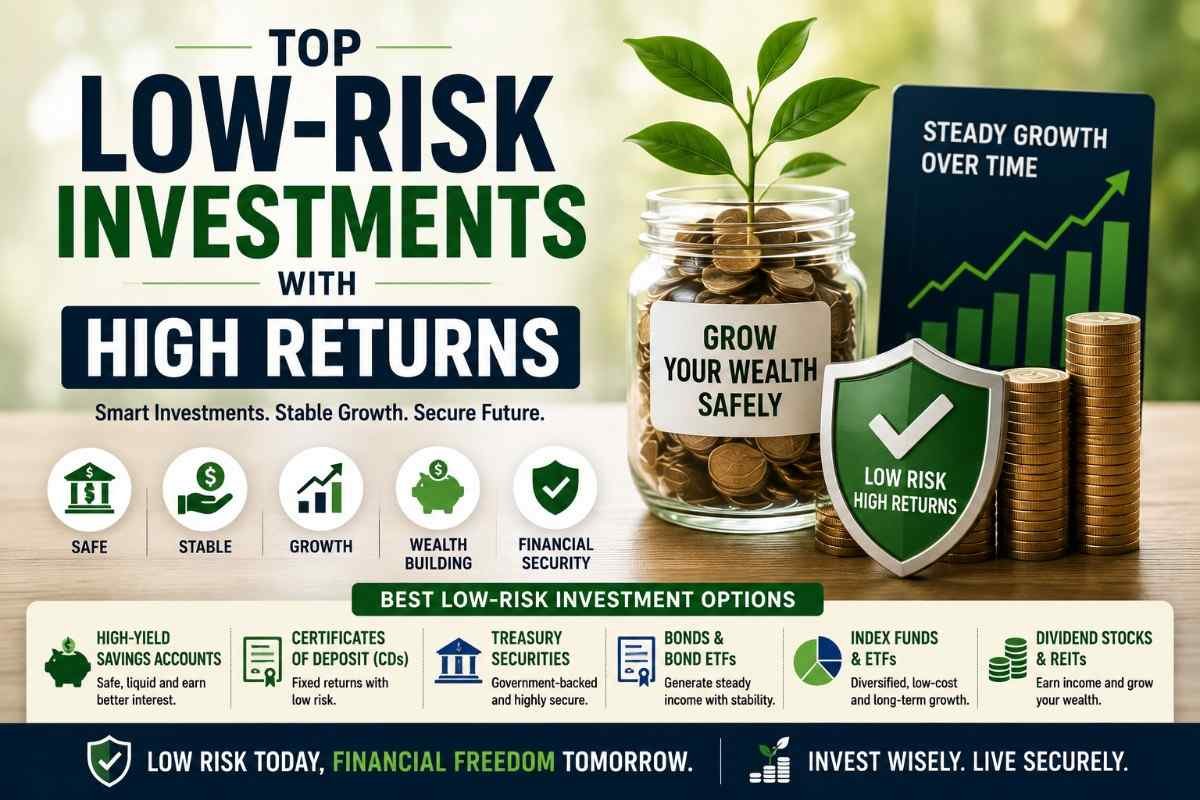
Top Low-Risk Investments with High Returns
Every investor wants the perfect combination of **low risk and high returns**. While no investment is completely risk-free, there are several investment options that offer a balance between protecting your capital and generating steady long-term growth.
Whether you’re just starting your investment journey, saving for retirement, building an emergency fund, or looking to diversify your portfolio, choosing the right low-risk investments can help you grow your wealth while minimizing unnecessary risk.
The key is understanding that **higher potential returns usually come with higher risk**. Instead of chasing unrealistic profits, smart investors focus on building a diversified portfolio of reliable investments that can generate consistent returns over time.
In this complete guide, we’ll explore the best low-risk investments with high return potential, explain how they work, discuss their advantages and disadvantages, and help you choose the right strategy for your financial goals.
—
What Are Low-Risk Investments?
Low-risk investments are financial assets designed to preserve your capital while generating stable returns.
Although returns may be lower than high-risk investments, these options generally experience less price volatility and provide greater financial security.
Low-risk investments are ideal for:
* Beginners
* Conservative investors
* Retirees
* Short-term financial goals
* Emergency savings
* Wealth preservation
—
Why Choose Low-Risk Investments?
Low-risk investing offers several benefits.
Capital Protection
Your original investment is generally less likely to experience significant losses.
### Stable Returns
Returns may be modest, but they are often more predictable than speculative investments.
Reduced Stress
Less market volatility means fewer emotional investment decisions.
Portfolio Diversification
Adding lower-risk assets can balance a portfolio that also includes higher-growth investments.
Better Long-Term Discipline
Steady investing helps investors remain committed to their financial plan.
—
1. High-Yield Savings Accounts
High-yield savings accounts offer one of the safest places to keep your money while earning interest.
### Advantages
* Very low risk
* Easy access to funds
* Ideal for emergency savings
* Interest compounds over time
Best For
* Emergency funds
* Short-term goals
* Conservative investors
Although returns may not always outpace inflation, these accounts provide excellent liquidity and security.
—
2. Certificates of Deposit (CDs)
Certificates of Deposit require you to leave your money invested for a fixed period in exchange for a guaranteed interest rate.
Benefits
* Fixed returns
* Low risk
* Predictable earnings
Drawbacks
* Early withdrawal penalties
* Less flexibility
CDs are suitable for money you won’t need immediately.
—
3. Money Market Accounts
Money market accounts combine features of savings and checking accounts.
Benefits include:
* Competitive interest rates
* Easy access to funds
* Strong capital preservation
* Check-writing features (at some institutions)
They are commonly used for short-term savings goals.
—
4. Treasury Securities
Government-issued treasury securities are considered among the safest investments available because they are backed by the issuing government’s credit.
Common types include:
* Treasury bills (T-Bills)
* Treasury notes
* Treasury bonds
Advantages
* Reliable income
* Low default risk
* Suitable for conservative portfolios
Treasuries are often used to preserve wealth during uncertain economic conditions.
—
5. Investment-Grade Bonds
Bonds issued by financially strong governments or corporations generally carry lower risk than speculative bonds.
Benefits
* Regular interest payments
* Lower volatility
* Diversification
Bond prices can fluctuate, but high-quality issuers typically offer greater stability.
—
6. Bond Exchange-Traded Funds (Bond ETFs)
Bond ETFs provide instant diversification across numerous bonds.
Advantages include:
* Professional management
* Lower risk than individual stocks
* Easy buying and selling
* Diversification
They are excellent for beginners seeking broad fixed-income exposure.
—
7. Index Funds
Index funds remain one of the best long-term investment options.
Instead of trying to outperform the market, they track a broad market index.
Benefits
* Low management fees
* Diversification
* Long-term growth
* Historically strong returns
While index funds experience market fluctuations, they have historically rewarded patient investors over long periods.
—
8. Exchange-Traded Funds (ETFs)
ETFs offer diversified exposure to different sectors, countries, or investment themes.
Popular categories include:
* Broad market ETFs
* Dividend ETFs
* Bond ETFs
* International ETFs
Advantages include:
* Lower costs
* Diversification
* Flexibility
* Transparency
—
9. Dividend Stocks
Dividend-paying companies distribute part of their profits to shareholders.
These investments offer:
* Regular income
* Potential capital appreciation
* Dividend reinvestment opportunities
Companies with long histories of consistent dividend payments are often considered relatively stable investments.
—
10. Real Estate Investment Trusts (REITs)
REITs allow investors to gain exposure to real estate without purchasing physical property.
Benefits include:
* Dividend income
* Portfolio diversification
* Professional property management
* Lower investment requirements than direct real estate ownership
REITs can be a practical way to add real estate exposure to a diversified portfolio.
—
11. Blue-Chip Stocks
Blue-chip companies are large, established businesses with long track records of profitability.
Characteristics include:
* Strong financial performance
* Stable earnings
* Global operations
* Reliable dividends (many cases)
Examples often come from sectors such as consumer goods, healthcare, banking, and technology.
—
12. Balanced Mutual Funds
Balanced funds invest in a combination of:
* Stocks
* Bonds
* Cash equivalents
This diversification helps reduce volatility while still providing growth potential.
They are especially suitable for beginners seeking a professionally managed portfolio.
—
13. Dollar-Cost Averaging
Dollar-cost averaging isn’t an investment itself but a strategy.
You invest a fixed amount regularly regardless of market conditions.
Benefits include:
* Reduced emotional investing
* Consistent investing habits
* Lower average purchase costs over time
This strategy works particularly well with ETFs and index funds.
—
14. Diversified Investment Portfolio
Rather than relying on one investment, spread your money across multiple asset classes.
Example allocation:
* 50% Index Funds
* 20% Bond ETFs
* 15% Dividend Stocks
* 10% REITs
* 5% Cash or High-Yield Savings
Diversification helps reduce overall portfolio risk while maintaining growth potential.
—
How to Choose the Right Low-Risk Investment
Before investing, consider:
Investment Goals
Are you saving for retirement, a home, education, or financial independence?
Time Horizon
Longer investment periods generally allow for greater exposure to growth assets.
Risk Tolerance
Understand how comfortable you are with temporary market declines.
Liquidity Needs
Determine whether you may need access to your money in the near future.
Diversification
Avoid placing all your money into one investment.
—
Common Investment Mistakes to Avoid
Avoid these common errors:
Chasing Unrealistic Returns
If an investment promises extremely high returns with little or no risk, approach it with caution.
Ignoring Fees
High management fees can reduce long-term returns.
Failing to Diversify
Putting all your money into one investment increases risk.
Panic Selling
Short-term market declines are normal. Emotional decisions can harm long-term results.
Waiting Too Long
Many beginners postpone investing because they believe they need a large amount of money.
Starting early is often more important than starting with a large balance.
—
Tips for Maximizing Returns While Managing Risk
* Invest consistently every month.
* Reinvest dividends whenever possible.
* Review your portfolio annually.
* Maintain a diversified asset allocation.
* Keep investment costs low.
* Continue improving your financial knowledge.
* Increase contributions as your income grows.
* Stay focused on long-term goals.
—
Frequently Asked Questions
Are Low-Risk Investments Completely Safe?
No. Every investment carries some degree of risk. However, low-risk investments are generally designed to reduce the likelihood of significant losses compared with more volatile assets.
—
Can Low-Risk Investments Generate High Returns?
Some low-risk investments can provide attractive long-term returns, especially when combined with diversification, consistent investing, and compound growth. However, there is typically a trade-off between risk and expected return.
—
Which Low-Risk Investment Is Best for Beginners?
Many beginners choose diversified index funds, broad-market ETFs, high-yield savings accounts for emergency funds, and high-quality bonds as a balanced starting point. The best choice depends on your goals, timeline, and risk tolerance.
—
How Much Should I Invest?
Invest an amount that fits comfortably within your budget while maintaining an emergency fund and avoiding high-interest debt. Consistent investing often matters more than the initial amount.
—
Final Thoughts
Building wealth doesn’t require taking excessive risks. By focusing on **low-risk investments with strong long-term potential**, you can protect your capital while steadily growing your financial future.
A diversified strategy that includes **high-yield savings accounts, treasury securities, investment-grade bonds, index funds, ETFs, dividend stocks, and REITs** can provide a healthy balance of stability and growth.
Remember that successful investing is about consistency, patience, and informed decision-making—not chasing quick profits. Start with investments that align with your financial goals, review your portfolio regularly, and allow time and compound growth to work in your favor.
The journey to financial security begins with making smart investment choices today.