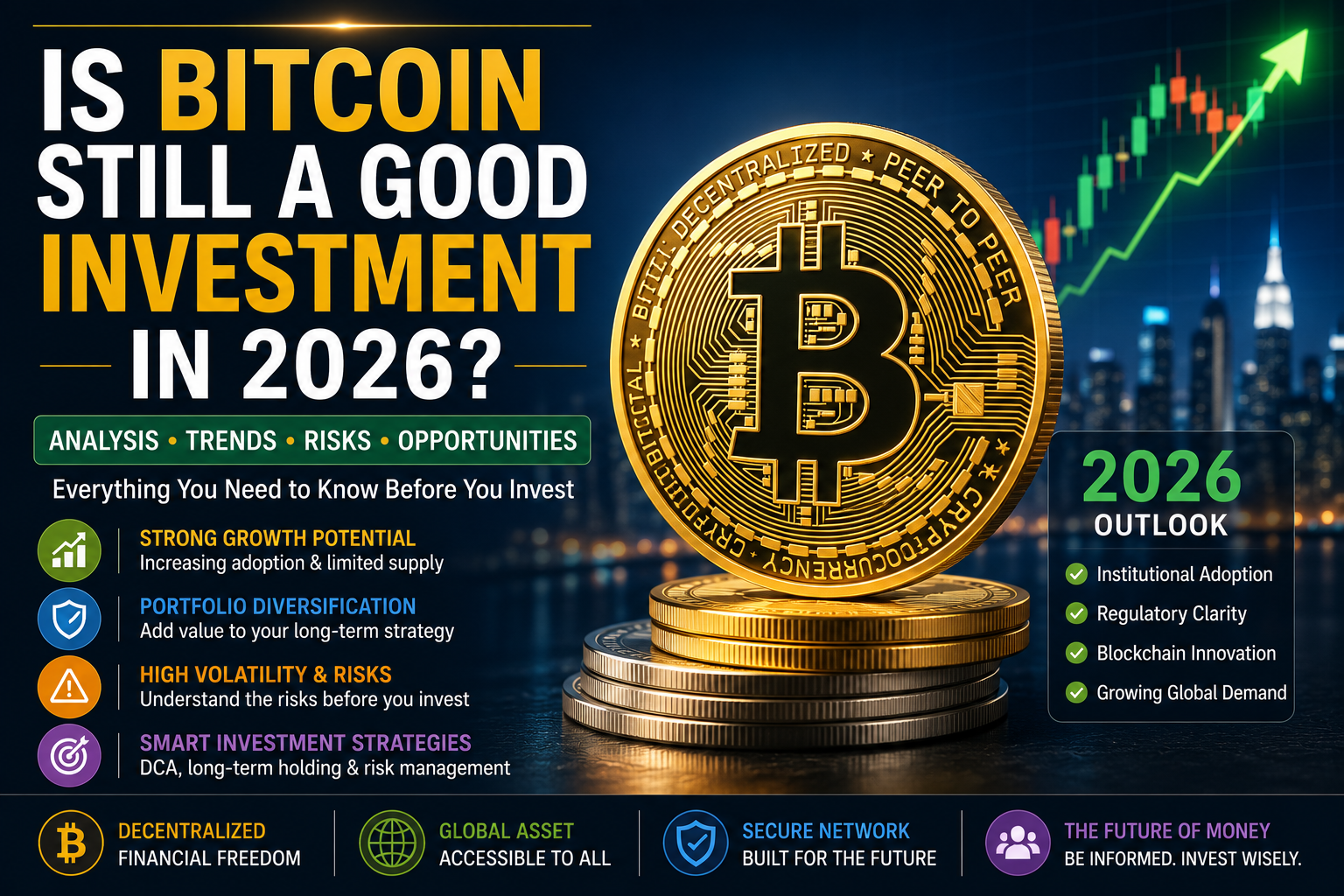
Is Bitcoin Still a Good Investment in 2026?
Bitcoin has transformed from an obscure digital experiment into one of the world’s most recognized financial assets. Since its launch in 2009, Bitcoin has experienced dramatic price increases, sharp market corrections, and growing acceptance from investors, businesses, and financial institutions.
As we move through **2026**, many investors are asking an important question: **Is Bitcoin still a good investment?**
The answer depends on your financial goals, risk tolerance, investment timeline, and understanding of cryptocurrency markets. While Bitcoin continues to attract long-term investors due to its limited supply and growing adoption, it also remains one of the most volatile asset classes available.
In this guide, we’ll explore Bitcoin’s potential, its risks, current market factors, and practical considerations to help beginners and experienced investors make informed decisions.
—
# What Is Bitcoin?
**Bitcoin (BTC)** is the world’s first decentralized cryptocurrency. Unlike traditional currencies issued by governments, Bitcoin operates on a decentralized blockchain network maintained by thousands of computers worldwide.
Key characteristics include:
* Limited maximum supply of **21 million coins**
* Decentralized network with no central authority
* Peer-to-peer transactions
* Transparent blockchain ledger
* Global accessibility
* Strong security through cryptography
Its limited supply is one reason many investors compare Bitcoin to digital gold.
—
Why Bitcoin Continues to Attract Investors
Bitcoin remains popular for several reasons.
Limited Supply
Only **21 million Bitcoins** will ever exist, making scarcity one of its defining features.
Global Adoption
Businesses, payment companies, institutional investors, and some governments have increased their exposure to Bitcoin over time.
Portfolio Diversification
Some investors include Bitcoin as a small portion of a diversified investment portfolio because its price movements may differ from those of traditional assets.
Long-Term Growth Potential
Supporters believe Bitcoin could continue benefiting from wider adoption and increasing acceptance as a digital asset, although future performance is uncertain.
—
Factors That Influence Bitcoin’s Price
Bitcoin prices are highly dynamic and influenced by many factors.
1. Supply and Demand
As with most assets, higher demand combined with limited supply can push prices upward, while weaker demand can lead to declines.
—
2. Institutional Adoption
Large companies, investment funds, and financial institutions entering the Bitcoin market can affect overall demand and market sentiment.
—
3. Government Regulations
Cryptocurrency regulations vary across countries and can influence investor confidence and market activity.
—
4. Interest Rates and Inflation
Macroeconomic conditions—including inflation, interest rates, and economic uncertainty—can influence demand for risk assets such as cryptocurrencies.
—
5. Market Sentiment
News events, technological developments, and investor psychology often contribute to Bitcoin’s short-term price volatility.
—
Advantages of Investing in Bitcoin
Potential for Long-Term Appreciation
Although past performance does not guarantee future results, Bitcoin has experienced significant long-term growth since its creation.
—
High Liquidity
Bitcoin is widely traded on major cryptocurrency exchanges, making it relatively easy to buy or sell.
—
Accessibility
Many investment platforms allow investors to purchase fractional amounts of Bitcoin, making it accessible even with small budgets.
—
Inflation Hedge (Debated)
Some investors view Bitcoin as a potential hedge against inflation due to its fixed supply. However, evidence has been mixed, and Bitcoin’s price can still fluctuate significantly during inflationary periods.
—
Innovation and Blockchain Technology
Bitcoin introduced blockchain technology, which continues to influence financial innovation and digital asset development.
—
Risks of Investing in Bitcoin
Every investment involves risk, and Bitcoin is no exception.
Extreme Price Volatility
Bitcoin’s price can rise or fall sharply over short periods. Investors should be prepared for substantial fluctuations.
—
Regulatory Uncertainty
Changes in laws, taxation, or regulations may affect cryptocurrency markets and investor participation.
—
Security Risks
While the Bitcoin network itself has proven resilient, investors still face risks such as:
* Exchange hacks
* Phishing attacks
* Scams
* Poor wallet security
* Loss of private keys
Using reputable exchanges and secure wallets is essential.
—
Market Sentiment
Bitcoin prices can react quickly to news and speculation, increasing short-term uncertainty.
—
Is Bitcoin Suitable for Beginners?
Bitcoin can be part of a beginner’s investment portfolio, but it should generally represent only a **small allocation** within a diversified investment strategy.
Beginners should:
* Learn how blockchain works.
* Understand cryptocurrency risks.
* Avoid investing money needed for essential expenses.
* Build an emergency fund before investing heavily.
* Diversify across different asset classes.
—
How Much Should You Invest?
There is no universal answer.
Many financial professionals suggest limiting higher-risk assets, including cryptocurrencies, to a modest percentage of an overall investment portfolio, depending on your goals and risk tolerance.
Invest only money you can afford to leave invested for the long term and tolerate significant fluctuations.
—
Bitcoin vs. Traditional Investments
| Feature | Bitcoin | Stocks | Bonds |
| —————- | —————— | ————————————- | —————– |
| Growth Potential | High but uncertain | Historically strong over long periods | Generally lower |
| Volatility | Very high | Moderate | Lower |
| Income | No regular income | Some companies pay dividends | Interest payments |
| Liquidity | High | High | High |
| Risk | High | Moderate | Lower |
Each asset class serves a different purpose. A diversified portfolio often combines multiple investments rather than relying on a single asset.
—
Strategies for Investing in Bitcoin
1. Dollar-Cost Averaging (DCA)
Instead of investing a large amount at once, invest a fixed amount regularly.
Benefits include:
* Reduces emotional investing
* Smooths purchase prices over time
* Encourages long-term discipline
—
2. Long-Term Holding
Some investors choose to hold Bitcoin for many years rather than reacting to short-term price movements.
This approach requires patience and a willingness to accept volatility.
—
3. Portfolio Diversification
Bitcoin should generally complement—not replace—other investments such as:
* Index funds
* ETFs
* Stocks
* Bonds
* Real estate
Diversification helps manage overall portfolio risk.
—
ommon Mistakes to Avoid
Avoid these common investing mistakes:
Investing More Than You Can Afford to Lose
Because Bitcoin is volatile, avoid investing money needed for bills or emergencies.
—
Chasing Price Surges
Buying based on excitement or fear of missing out (FOMO) can lead to poor decisions.
—
Ignoring Security
Protect your investments by using strong passwords, two-factor authentication, and reputable wallets or exchanges.
—
Failing to Research
Understand how Bitcoin works before investing.
Knowledge helps reduce emotional decision-making.
—
Neglecting Diversification
Relying entirely on one asset increases risk. A balanced portfolio can improve long-term resilience.
—
Tips for Beginner Bitcoin Investors
If you’re considering Bitcoin:
* Start with a small amount.
* Invest regularly rather than trying to time the market.
* Diversify your portfolio.
* Focus on long-term goals.
* Stay informed about regulations and market developments.
* Avoid making decisions based solely on social media trends.
Patience and discipline are often more valuable than reacting to short-term price swings.
—
Frequently Asked Questions
Is Bitcoin Safe?
Bitcoin’s blockchain has proven resilient over time. However, investing in Bitcoin carries market risk, and investors must also protect their accounts and private keys from theft or fraud.
—
Can You Lose Money Investing in Bitcoin?
Yes. Bitcoin’s price can fluctuate significantly, and there is no guarantee of profit. Investors should be prepared for periods of substantial declines.
—
Is Bitcoin Better Than Stocks?
Bitcoin and stocks have different risk and return characteristics. Stocks represent ownership in businesses and may pay dividends, while Bitcoin is a digital asset with no cash flows. Many investors choose to hold both as part of a diversified portfolio rather than viewing them as direct substitutes.
—
Is Bitcoin a Good Long-Term Investment?
Some investors believe Bitcoin has long-term potential due to its limited supply and growing adoption. However, future performance is uncertain, and there are no guarantees. Decisions should be based on your financial goals, risk tolerance, and overall investment strategy.
—
Final Thoughts
Bitcoin continues to be one of the most discussed investments in 2026. Its limited supply, widespread recognition, and increasing institutional interest have helped establish it as a significant digital asset. At the same time, its high volatility and evolving regulatory environment mean it is not suitable for every investor.
If you decide to invest in Bitcoin, consider making it only one part of a diversified portfolio, invest with a long-term perspective, and avoid committing money you cannot afford to keep invested through market fluctuations.
Successful investing is not about predicting short-term price movements—it is about building a disciplined strategy that aligns with your financial goals. By understanding both the opportunities and the risks, you can make more informed decisions about whether Bitcoin fits into your overall investment plan.